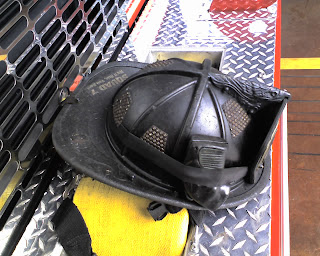
Saturday, January 23, 2010
Everything was going along wonderfully until about 3 weeks later. One day, a really good looking angel walks by and the firefighter turns his head and grins. Of course, all of a sudden, his wings fall off. Well, when he bent over to pick them up, the cops wings fell off.
Friday, January 22, 2010
Pet peeves
People that don't stand up to supervisors when given orders that directly contradict doing the right thing. Especially if doing the right thing would only take 5 more minutes (and you're already out of service anyways).
Saturday, January 16, 2010
Close call
There were problems with water supply, nozzle placement, communication, equipment, and more.
We were lucky. We were extremely lucky.
The crew assigned to water supply was not the crew that completed the assignment. Another unit said they'd dress the hydrant and the original crew moved on to a new assignment. Because of what I personally feel was a poor decision, the crew that dressed the hydrant slowed the process. They chose to flush the hydrant before attaching the 2 1/2" to Stortz, and never put a ball valve on the other side. The hydrant had to be flushed, closed, dressed, and charged. It felt a lot longer than it actually was I'm sure, but it still took a long time.
The 2nd line off the pumping engine ended up in a dead end, at the opposite end of the hallway from where it needed to be. Too many firefighters were cramming into the space and communication deteriorated. We think the crews outside were flowing water and pushed the fire onto the crews with the 2nd line. The flames rolled over 2 times, and both times I was on my knees because of the heat (most of us were pretty low) and the flames were near eye-level.
After the rollovers, the nozzle finally got moving in the right direction and we got water on the fire.
1 person experienced a major malfunction of their SCBA and was breathing hot smoke. He is doing fine now, but a rookie from his station was scared to death that he was seriously hurt. I'm unclear right now as to the finer details of the malfunction. I heard something about the facepiece may have cracked, or the regulator wasn't locked in all the way, or whatever. I'm not going to speculate because I don't know the real answer. I'm just glad he wasn't seriously hurt.
At some point or another, pretty much everyone was some degree of disoriented. I know of at least 2 guys that lost the hoseline and weren't sure exactly where they were or where the hose went.
After a short scare, all occupants were located and accounted for.
The fire was stopped and the majority of the house escaped fire and water damage. The roof was intact, the occupants are alive and unscathed, their property can be cleaned, rebuilt, or replaced.
We all went home at the end of the shift.
I'm still tired, even though I came home and slept roughly 9 hours. I'm sore, I'm sooty, and I smell like a BBQ pit. Yet, I'm content. I'm extremely dissatisfied with how the fire went, but everyone did do a good job overall, and just getting to go into a fire makes my day.
I hope we are able to get some of the crews together next shift and go over what happened and see the different perspectives. It doesn't seem to be done as much lately and this call definately needs a field-level review. I know the powers-that-be review every fire, but so should we.
Wednesday, January 13, 2010
My Office
I take a lot of pride in trying to know as much about my truck as I can, and I have a lot of information still to learn. I want to know everything from how many GPM's my truck will pump, to how many discharges of each size it has, to how many lugnuts are on the wheels. It's part of being a good driver in my opinion.
Welcome to my office
**note- image is from photobucket, not my truck**
I have not had the fortune of working for any captains that were what's now considered "Old School." I've taken part in some training that I believe is tradition, but nothing I've seen many folks put through regularly.
My first shift out of the academy, I brought donuts, set them on the table, and sat back out of the way. Once the shift started and I was shown where to put my gear and how to work the SCBA release in the seats, I was told I was not allowed to enter any part of the station other than the bay until I knew where everything was at on my engine.
I opened every compartment and spent some time going around and around that truck. When I finally felt comfortable enough, I entered the day room and was immediately quizzed by the guys. Since I answered everything correctly, I was allowed to stay, and sit down. I understood the reasoning then, and I'm thankful for the lesson it taught me. To this day, I can walk around an engine and really look at the compartments 1 time, and I'll remember where things are. It doesn't even take 5 minutes of my time.
Once I started learning about friction loss and other driver-specific duties, I had a very difficult time getting help. I was in a different crew, and the man I once looked to as my mentor had already retired. My shifts were spent on the ambulance, every shift that passed, I was on the ambulance. The truck was extremely busy, and I rarely was able to eat a warm dinner, much less study friction loss or practice pumping the engine at my station. For this, I blame that captain.
I took my personal time and attended a fireground hydraulics class offered by the state academy. I purchased and read, cover to cover, the IFSTA manual on Engine Operator. I took more time on my days off to go drive reserve engines around the academy, under the supervision of the instructors, to help build enough hours to meet the requirements to even take the test for pump school.
I felt the need to do all of these things because I wasn't getting the experience or help I felt I needed at the station-level.
When I took the entrance test for pump school, I passed, and few have ever matched or beat my score (so I've been told). The practicals testing was nerve-wracking, you know they are looking at everything. I had to repeat 1 part. You have to flow a 1 3/4" crosslay wide open, and you better get your own water supply before you cavitate. Oh, and make sure the TPM is set, a spike of more than 30psi on the line is grounds for failure. My first attempt, I was just a bit too slow and cavitated (no harm was done to the truck, the instructor stands by the pump panel to shut it down if needed, and the firefighter on the nozzle also closes the bale when he hears the engine over-rev).
I do not have the luxury of having the experience of pumping many many fires, but I do my best at every opportunity and the guys manning my hoselines have never brought any complaints to me. I look forward to pumping more fires, it's hard work, but it's a blast. The only bad thing about pumping, is having to stay outside with the truck.
I don't want to be a 2/20 firefighter, but I'm not afraid to share what information I do know. I managed to teach a veteran guy how to pressurize a watercan by backflowing the air up the nozzle. I can't begin to list the things I've been taught.
Like I said, I take a lot of pride in the things I've learned. Any of you folks out there that are fire guys, please feel free to share random bits of info that might be helpful, or rack my brain to see what I know. Non-fire folks, send me any questions you have about the things we do, why, or how we do them. If I don't have a good answer for you, I'll do my best to find one.
Friday, January 8, 2010
A rare sight

Yup, that's what it looks like outside my bedroom.
I love the snow, but that may be because I don't see it very often. Of course, everyone in town has lost their damn minds. There was a 27 or 29 car pileup, and a deputy that spun out and the off-duty officer that stopped to help had to jump off a 20 ft high bridge when another car lost control and came at them. The news is saying they'll both be ok, but no idea about their actual injuries.
I just got back from heading to the bank to make a deposit and get food, and the roads look decent. I didn't have any issues, and the only ice I crossed was in the shopping center parking lot. A roughly 250' long stretch of road that was covered. I jut let the car idle forward and didn't have any problems. My backyard is another story though. It's 22*F now, and once the sun drops, it's going to freeze solid very quickly. The ice will be over 1" thick.
I'm praying for all the guys and gals that have to work in this junk.
I was evil this morning though. I was able to make ice cream from the snow. It was awesome, very tasty. If the snow doesn't get that crunchy layer of ice on it, I might make more in the morning. I have to get my fix while the snow lasts, because it may not snow for another year around here.
Thursday, January 7, 2010
Never thread a tiny needle with big yarn
Amazingly, these idiots were fairly unscathed. Their car will probably be totalled, since the engine dropped and was sitting at a weird angle.
The call came in as an entrapment, but all occupants of the vehicle were able to crawl out through the windows before any units arrived onscene. 2 of the 3 ended up on backboards and in C-collars since they had complaints, the other guy refused care.
I thought the driver's cell phone was going to have to be surgically removed, he interfered with his own care by ignoring our orders to stop making calls so we could assess him, and finished calling everyone in his phone book. The refusal guy just kept getting into the back of the ambulance and was pretty much just in the dang way the whole time. I finally made a smartassed comment to one of the engine guys and he got the guy out of my way.
As soon as I got in the cab to drive to the ER, refusal guy made some comment to me along the lines of "you gonna drive *this* truck?" I turned and looked at him and the filter between my brain and mouth failed (hey, it was 0230), "I've been driving it longer than you."
He said some other rude comment and I replied that I got paid to drive that truck, and he was quiet the rest of the ride.
At the hospital, the nursing staff commented about the hispanic gang that had arrived in the waiting room. I told them about the cell phone issues. They had their hands full trying to keep the driver in his room (and not walking around on the ankle he was supposed to have X-ray'd), and keeping the other visitors from sneaking into the rooms with the guys.
In other news, it's actually snowing! The ground here has a light dusting of snow and it's still falling. I'm so glad I'm off work for a couple of days, folks around here don't know how to drive even on dry roads.
I just hope enough falls so I can make ice cream. I have sugar, milk, and vanilla extract ready and waiting!
Sunday, January 3, 2010
Exactly how it's supposed to work
We arrived onscene and found our patient looking pretty crappy. He was complaining of chest discomfort and nausea, among other things. We didn't waste any time in getting him on the stretcher and into the ambulance. He was placed on the monitor, and a 12-lead was also run as soon as we were able. His nausea got the better of him and he vomitted. As quickly as we could manage, he got a diesel drip to the hospital. Our onscene time was between 5-10 minutes total.
On arrival at the hospital, we spent just long enough in the ER to have a STEMI chart grabbed, timer started, and for a nurse to come show us the way to the cath lab.
I kid you not when I say that we moved the patient from our stretcher onto the cath lab table, and were kicked out of the room.
I made a comment to my partner about wishing we could stay an watch, because it had to be a interesting procedure. Well, one of the nurses said to just go into the observation room and watch, stating that it's only a 15 minute procedure. Don't have to tell me twice, we moved our stretcher to an out of the way place, and went to watch.
All I can say is wow. It's so very neat to watch. Our guy had a right inferior block. The stint was placed and he converted back to a normal rhythm right before I left to go put my truck back in order.
Total time from initiation of 911 to stint placement was at or just shy of an hour. I'd have to pull the report to be sure, since we don't track arrival to the ER in our station logs.